


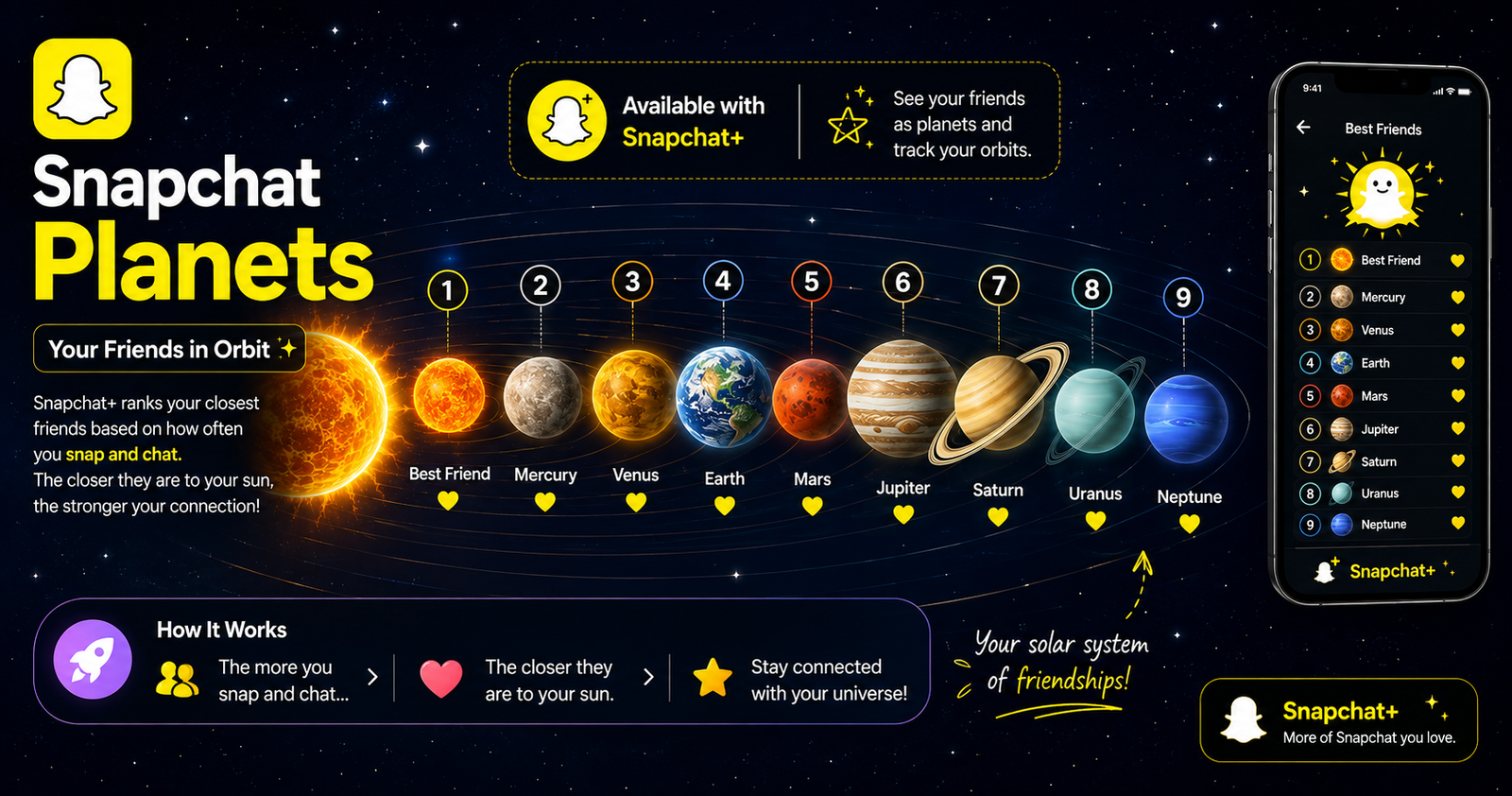
If you’ve ever tapped on a friend’s Bitmoji and noticed a tiny planet badge hovering near their name, you’ve stumbled onto one of Snapchat’s most talked-about hidden features. It’s not a glitch, and it’s definitely not random. That little planet is quietly telling you — and only you — exactly where you rank in that person’s circle of closest friends.
This guide walks through the snap planets order from Mercury to Neptune, explains what each position actually signals, and clears up the confusion around Snapchat Plus planets that keeps popping up in comment sections and group chats.
What the Snapchat Friend Solar System Actually Is
The feature is officially called the Friend Solar System, and it’s exclusive to Snapchat Plus subscribers. Once you turn it on, you become the “Sun” of your own personal system, and your eight most-interacted-with friends get placed as orbiting planets around you.
The logic mirrors real astronomy: the closer a planet sits to the Sun, the tighter that friendship is, based on how often you snap, chat, and keep streaks going with that specific person. It’s a private ranking — nobody else can see how you’ve ranked them, and you can’t see how they’ve ranked you either, unless their account also shows it to you separately.
One thing worth noting: this isn’t the same as your Snap Score. Snap Score reflects your total activity across the entire app. The Friend Solar System is calculated per-friendship, so a person with a modest overall Snap Score could still land in your Mercury spot if the two of you talk constantly.
Snapchat Planets in Order: Mercury to Neptune
Here’s the full snap planets order, from closest to farthest:
| Position | Planet | What It Means |
|---|---|---|
| 1 | Mercury | Your #1 closest friend by interaction |
| 2 | Venus | Your #2 closest friend |
| 3 | Earth | Your #3 closest friend |
| 4 | Mars | Your #4 closest friend |
| 5 | Jupiter | Your #5 closest friend |
| 6 | Saturn | Your #6 closest friend |
| 7 | Uranus | Your #7 closest friend |
| 8 | Neptune | Your #8 closest friend |
Mercury, being the planet nearest the Sun in real life, represents the friend you interact with the most — the person you’re constantly snapping back and forth with. Neptune, sitting at the far edge, still makes your top eight, but the connection tends to be lighter or more occasional.
A common mix-up I see is people assuming a Neptune ranking means the friendship is fading or unimportant. In practice, this usually just means the interaction volume is lower relative to your other close friends — you can still be genuinely close with someone who lands on Neptune, especially if your communication happens more through calls or in person than through the app itself.
How the Ranking Is Actually Calculated
Snapchat hasn’t published an exact formula, and it’s worth being upfront about that rather than guessing at numbers that don’t exist. What’s consistently reported by users and covered across tech outlets is that the system weighs a combination of:
- Snap frequency (how often you send photos/videos back and forth)
- Chat activity (text messages exchanged)
- Streak length and consistency
- Story replies and interactions
A useful way to think about it: imagine two friends, Ali and Sara. Ali sends you five snaps a day and keeps a 200-day streak going, but rarely replies to your stories. Sara sends fewer snaps but chats with you constantly throughout the day and always reacts to your stories. Depending on how the algorithm weights these signals, either one could realistically land closer to Mercury — it’s the combined pattern of engagement that matters, not any single metric in isolation.
Rankings Update, But Not Instantly
If you notice your position on someone’s solar system hasn’t moved even after a big spike in messaging, that’s normal. The system refreshes periodically rather than in real time, so there’s usually a short lag between a change in behavior and a change in planet placement.
Snapchat Moons and What’s Rolling Out Beyond Planets
Alongside the core planets, Snapchat has been testing and adding smaller extras to keep the Friend Solar System feeling fresh — think refined animations when a planet shifts position, new Bitmoji-based reactions inside the feature, and experimental badges tied to consistent interaction streaks. These additions don’t change the core snapchat planets in order logic; they layer extra visual flair on top of the same eight-planet ranking.
If you’re seeing terminology around “moons” or badge variations circulating on social platforms, treat it as an evolving part of the feature rather than a separate ranking system. The eight-planet order remains the foundation.
How to Turn On (or Find) Your Planets
A few practical notes if you’re trying to actually see this feature:
- You need an active Snapchat Plus subscription — the Friend Solar System isn’t available on the free tier.
- It’s off by default. After subscribing, you have to manually enable it in your settings.
- Both people generally need Snapchat Plus for the planet badge to show up on each other’s profiles.
- It currently works through the Snapchat mobile app on Android and iOS.
If a friend’s profile isn’t showing a planet at all, the most likely explanations are that their subscription lapsed, they’ve turned the feature off, or you two simply haven’t built up enough Plus-tracked interaction yet for a ranking to appear.
Common Myths, Cleared Up
“If I can see their planet, they can see mine.” Not necessarily — each person’s solar system is independent. You could be ranked as someone’s Mercury while they show up on your side as Saturn. The two rankings don’t have to match, and there’s no requirement that they do.
“A low ranking means the friendship is bad.” Not really. It reflects app-based interaction frequency specifically, not overall friendship quality. Plenty of close friendships lean more on phone calls, hanging out in person, or other apps entirely.
“Planets are gone now — my friend doesn’t have one.” The feature is still active. A missing badge almost always comes down to subscription status or a friend disabling the setting, not the feature being discontinued.
Making Sense of Your Own Rankings
If you’re genuinely curious about where you stand with someone, the more reliable approach is to just look at your actual snap and chat history with them rather than trying to reverse-engineer the algorithm. The planet is a fun visual summary of a pattern that’s already visible in your conversation threads — streaks, response times, how often you’re the one initiating.
If a ranking surprises you, that’s usually a decent nudge to check whether your day-to-day interaction with that person matches how close you actually feel to them. The badge is a small, low-stakes way to notice patterns you might not otherwise pay attention to — not a verdict on the friendship itself.
Read Also : Cybersecurity Mistakes Small Businesses
