


If you’ve searched this exact phrase, you’re probably trying to figure out what it means and whether it’s something you need to act on. Here’s the short answer: it’s not an official, documented term from BrandRank.ai itself — but it points to a real and increasingly important practice: cleaning up brand data so AI systems can recognize a brand consistently.
This article explains what that process actually involves, why it’s become relevant now, and how it connects to BrandRank.ai’s actual public methodology.
A quick clarification worth knowing upfront
Searching BrandRank.ai’s own website, documentation, and FAQ turns up no framework, product, or feature officially called “normalization transformation rules.” The phrase seems to have originated in third-party explainer content rather than from BrandRank.ai itself.
What BrandRank.ai does publicly name is its Brand Health and Trust framework, introduced in 2026 through a partnership with consumer-insights firm Burke, Inc., alongside a diagnostic tool called BRAND ANSWER. If you came here looking for BrandRank.ai’s actual product methodology, that’s the accurate name to search for.
With that distinction made, the rest of this guide treats “normalization transformation rules” the way most existing content does: as a practical, informal way of describing brand data normalization and transformation — a real discipline that matters regardless of which specific tool or vendor applies it.
Why brand data normalization matters right now
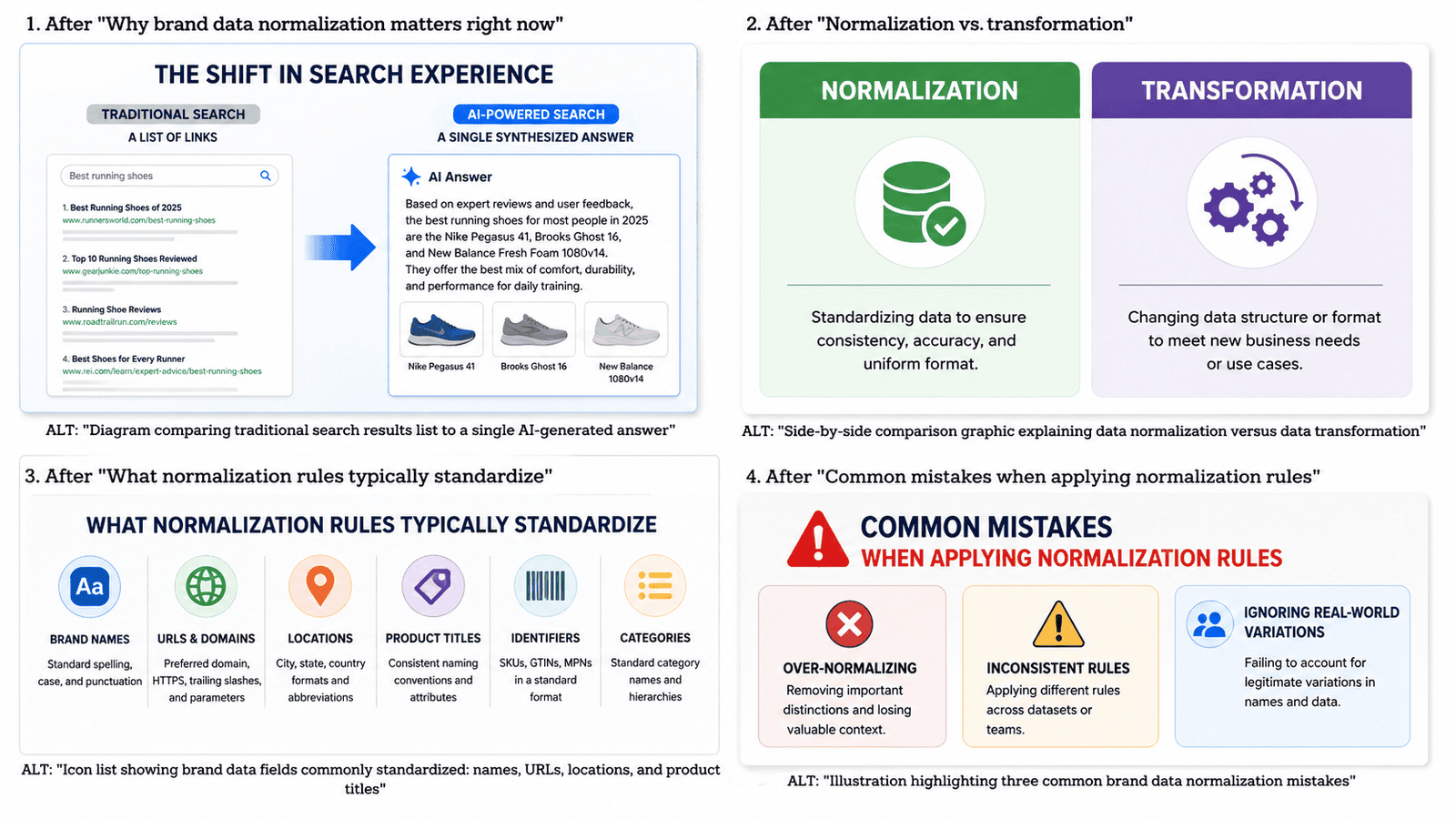
For most of the last two decades, being findable online meant ranking on a search results page. That model is shifting. Tools like ChatGPT, Gemini, Claude, and Perplexity increasingly read across many sources and hand back one synthesized answer instead of a list of links.
For an AI system to cite a brand accurately inside that answer, it first has to recognize that different mentions — “Acme Corp,” “Acme Corporation,” “acme-corp.com,” “Acme Inc.” — all refer to the same entity. A person makes that connection instantly. A machine only makes it if the underlying data has been normalized into a consistent format.
Normalization vs. transformation: what’s the difference?
These two words get used almost interchangeably in this space, but they describe slightly different things.
Normalization takes data that’s already there and makes it consistent — standardizing brand names, addresses, or product titles so every reference to the same entity looks identical to a machine.
Transformation is the broader process of reshaping data from one structure or format into another, often for a new purpose entirely.
In practice, normalization is best understood as one specific type of transformation — the type focused on consistency rather than restructuring. Most real data pipelines use both together: transformation to get data into a workable shape, normalization to make sure it’s consistent once it’s there.
What normalization rules typically standardize
When people talk about “brand data normalization,” they’re usually referring to cleanup across a specific set of fields:
- Company and brand names — casing, abbreviations, legal suffixes (Inc., LLC, Corp.)
- Product titles and categories — so the same product isn’t listed three different ways
- URLs and domains — collapsing www/non-www, http/https, and subdomain variants into one canonical reference
- Locations and addresses — standard formatting across regions
- Citations and source attribution — matching mentions back to the correct entity
- Competitor references — distinguishing similarly named brands from one another
The end goal is one clean, canonical record per brand — so a report, a dataset, or an AI system doesn’t accidentally treat the same company as two separate entities.
Common mistakes when applying normalization rules
A few failure patterns show up repeatedly in this kind of data work:
- No exception handling. Some brands deliberately break standard casing or naming conventions — think “iPhone” or “eBay.” A rigid rule set that “corrects” these actually introduces errors instead of fixing them.
- Overwriting the original data. If the raw, unnormalized record isn’t preserved alongside the cleaned version, there’s no way to audit changes or roll back a mistake later.
- Treating it as a one-time project. Brand data drifts constantly — new product lines, rebrands, mergers, domain changes — so normalization needs ongoing maintenance, not a single pass.
How this connects to AI visibility
AI answer engines interpret entities and relationships, not just keywords on a page. When a brand’s name, metadata, and structured data are inconsistent across the sources an AI model draws from, the model may under-cite the brand, misattribute information to it, or blend it with a similarly named competitor.
Clean, normalized data doesn’t guarantee a citation in an AI-generated answer. But messy, inconsistent data makes accurate citation significantly less likely — which is why this kind of data hygiene has become a genuine consideration for brand and SEO teams, not just a back-office task.
Common questions
Is “BrandRank.ai normalization transformation rules” an official product feature? No. There’s no evidence of an official framework by this exact name on BrandRank.ai’s website or documentation. BrandRank.ai’s publicly named methodology is the Brand Health and Trust framework.
Do I need special software to normalize brand data? Not necessarily. Basic normalization can be done with spreadsheet rules or scripts for smaller datasets. Dedicated platforms become more useful as the number of sources and brand mentions grows. For a deeper look at how brand data and AI visibility connect, see Vaulten Media.
Does normalized data guarantee better AI citations? No single fix guarantees citation frequency. Normalization removes one barrier to accurate recognition, but AI visibility also depends on the quality, authority, and consistency of the content itself.
The bottom line
“BrandRank.ai normalization transformation rules” isn’t an official term, but the concept behind it is real and worth taking seriously: consistent, well-structured brand data helps AI systems recognize and cite a brand accurately. Whether you use BrandRank.ai, a different platform, or your own internal process, the core discipline is the same — standardize the data, preserve the original records, and revisit the rules regularly as your brand evolves.
