

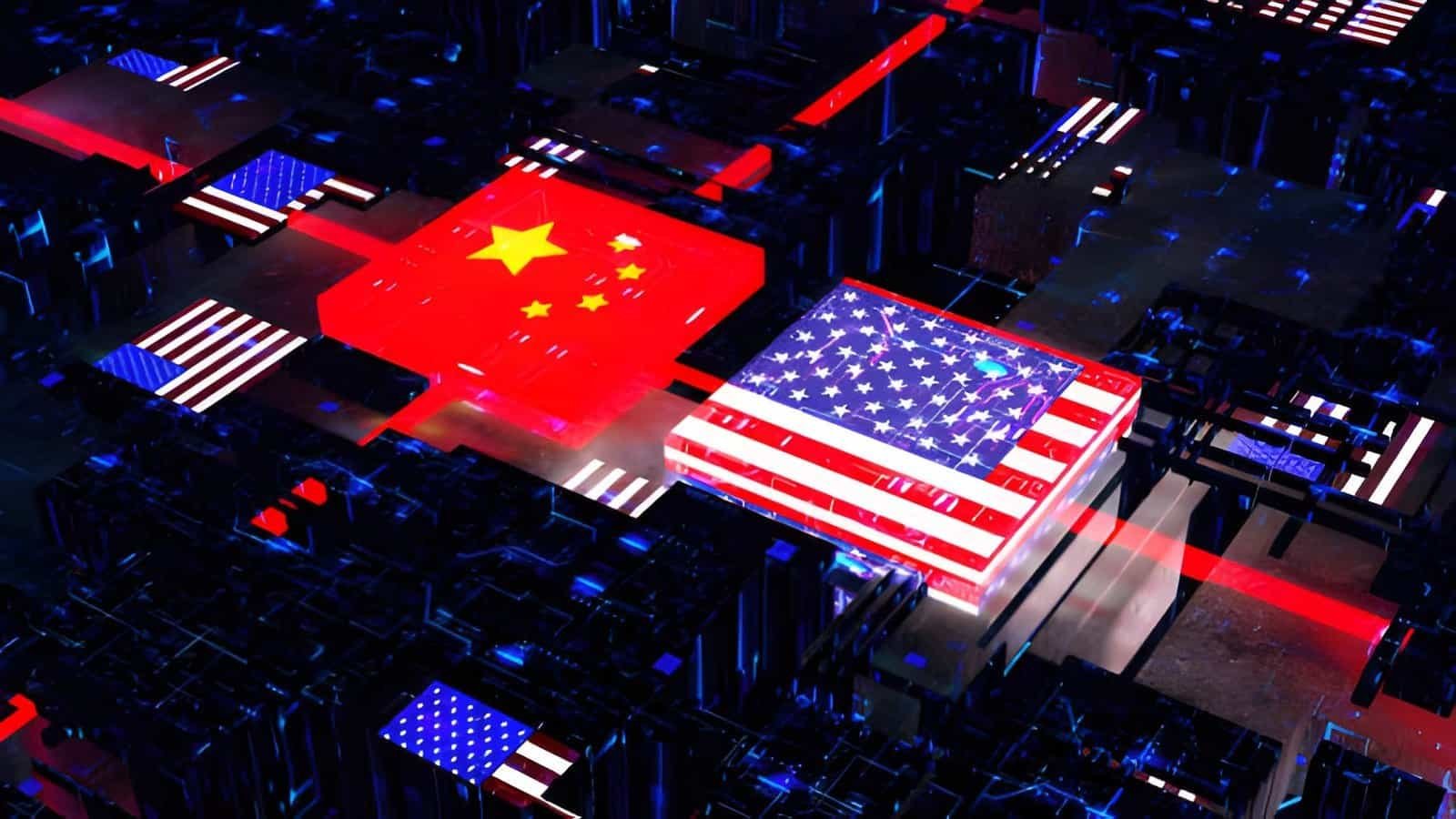
The US China Technology Competition Dimon discussion sits at the intersection of technology, finance, national security, and global economic power. The rivalry between the United States and China is no longer limited to tariffs, manufacturing, or trade balances. It increasingly centers on artificial intelligence, semiconductors, robotics, data infrastructure, cybersecurity, advanced computing, and critical supply chains.
Jamie Dimon, chairman and CEO of JPMorgan Chase, provides a particularly useful business perspective because his role connects financial markets with corporate investment, international commerce, and geopolitical risk. His comments on technology and China are therefore relevant not only to investors but also to executives deciding where to place capital and how to manage increasingly fragmented global supply chains.
In 2026, the stakes have become even higher. China has continued to close the technological gap in artificial intelligence while developing cost-efficient and increasingly open AI models. At the same time, the United States retains major advantages in frontier AI, capital, advanced computing infrastructure, and technology companies. Brookings describes the two countries as pursuing substantially different AI strategies, with the U.S. stronger in frontier software and commercial ecosystems while China has developed notable strengths in physical AI and industrial deployment.
Why the US-China Technology Competition Matters
The technology rivalry matters because technological leadership increasingly translates into economic productivity, military capability, financial influence, and control over global standards.
Semiconductors are a clear example. Advanced chips are essential for AI systems, data centers, smartphones, autonomous vehicles, advanced weapons, and countless industrial applications. Restrictions on advanced semiconductor technology have consequently become a major component of U.S. policy toward China.
Artificial intelligence has added another dimension. The competition is no longer simply about producing the most powerful model. It is also about who can deploy AI most efficiently, who controls the necessary computing infrastructure, who develops the strongest talent base, and which country’s AI ecosystem becomes embedded globally.
Recent developments show how quickly the balance can change. Chinese companies have released increasingly capable open-weight models, while U.S. companies continue to benefit from enormous capital availability and access to advanced computing resources. The Washington Post reported in July 2026 that Chinese AI models had rapidly narrowed some capability gaps with leading American systems.
Jamie Dimon’s View of Technology and Strategic Competition
Jamie Dimon’s perspective is particularly important because he generally approaches technology through the lens of business resilience, productivity, investment, and national competitiveness rather than treating technology as an isolated industry.
At the World Economic Forum in Davos in 2026, Dimon explained that JPMorgan does not view AI as something completely separate from technology. Instead, technology has historically been a force that changes virtually every part of a business, which is why technology leadership has remained integrated into the bank’s management structure.
That philosophy helps explain why the US China Technology Competition Dimon keyword has broader significance than a simple search about one executive’s comments. Dimon’s position illustrates how technology competition is increasingly viewed by corporate leaders as a strategic business issue.
For large companies, the question is not simply whether the United States or China develops the better technology. The more practical questions are:
- Where should critical infrastructure be built?
- Which suppliers can be trusted during a geopolitical crisis?
- How much dependence on a single country is acceptable?
- Which AI technologies should businesses adopt?
- How should companies manage cybersecurity and data risks?
- How can firms maintain productivity if technology supply chains become fragmented?
These questions turn geopolitics into an everyday corporate planning issue.
Artificial Intelligence Is Becoming the Central Battleground
AI has rapidly become one of the most important areas of U.S.-China technological competition.
The United States continues to possess major advantages in frontier AI research, venture capital, computing infrastructure, and leading AI companies. China, however, has demonstrated impressive progress in developing efficient models and deploying AI throughout manufacturing and other parts of the real economy.
A 2026 analysis from Boston Consulting Group found that the United States maintains advantages in frontier models, talent, and capital deployment, while China has made significant progress in cost-optimized AI and large-scale adoption. The analysis also noted that the technology ecosystems of the two countries are becoming increasingly difficult for companies to combine.
This is an important shift.
Previously, a multinational company could often treat technology sourcing as a primarily economic decision. Today, technology procurement can also be a geopolitical decision.
A company choosing an AI model, cloud provider, semiconductor supplier, or data infrastructure partner may need to consider export controls, cybersecurity, intellectual property, regulatory exposure, and future access to critical components.
Semiconductors and the Battle for Computing Power
The semiconductor industry remains one of the strongest examples of how technology has become intertwined with national strategy.
Advanced AI requires enormous computing resources. Without sophisticated processors and data centers, even the best algorithms cannot operate at global scale.
The United States therefore has a major strategic advantage through its semiconductor design ecosystem and access to leading AI infrastructure. China has responded by accelerating efforts to develop domestic alternatives and reduce dependence on foreign chips.
This creates a feedback loop.
More domestic Chinese semiconductor capability can reduce China’s vulnerability to export restrictions. Meanwhile, U.S. restrictions can encourage Chinese companies to invest more aggressively in alternative technologies. At the same time, American companies face pressure to preserve technological leadership without unnecessarily damaging their own commercial markets.
The result is a competition in which innovation and industrial policy reinforce each other.
Supply Chain Resilience Through the Dimon Lens
Supply-chain resilience is another major theme when examining the US China Technology Competition Dimon relationship.
Dimon’s broader warnings about dependence on foreign sources have attracted attention because modern economies rely on incredibly complex international supply chains. A disruption involving one country can quickly affect manufacturing, healthcare, energy, electronics, finance, and transportation.
Technology makes this vulnerability even more significant.
A semiconductor shortage can slow automobile production. A shortage of critical minerals can affect battery manufacturing. Restrictions on advanced computing equipment can change the economics of AI development.
The lesson for businesses is not necessarily that every supply chain must be completely separated from China. Instead, companies increasingly need to determine which dependencies are strategic and which are replaceable.
This distinction is crucial.
Total decoupling can be enormously expensive, while excessive dependence can create unacceptable strategic risks. The more realistic approach for many businesses is diversification, redundancy, alternative suppliers, and contingency planning.
China’s Growing Technology Strength
China should not be viewed simply as a follower in the global technology race.
The country has developed significant capabilities in AI, electric vehicles, robotics, industrial automation, telecommunications, batteries, and advanced manufacturing. Its enormous domestic market also gives companies the ability to test and scale technologies quickly.
China’s approach to AI differs from the U.S. approach in several important ways. Chinese companies have increasingly emphasized efficiency, open-weight models, and practical industrial applications. Research cited by Brookings highlights China’s strength in physical AI and its focus on integrating AI into manufacturing and other real-world applications.
This means the competition cannot be measured solely by asking which country has the most powerful AI model.
A country could potentially gain enormous economic benefits by deploying slightly less powerful AI at dramatically lower cost across factories, logistics networks, financial institutions, and public infrastructure.
The American Advantage Is Still Significant
Despite China’s rapid progress, the United States retains substantial advantages.
American technology companies continue to dominate important areas of advanced AI development, while the country benefits from deep capital markets, world-class universities, highly developed venture funding, and a powerful technology ecosystem.
BCG’s 2026 assessment found that the United States maintained a lead in frontier AI, talent, and capital deployment.
However, leadership should not be confused with permanent dominance.
The recent acceleration of Chinese AI development demonstrates that technological advantages can narrow surprisingly quickly. The Washington Post reported that the gap between some Chinese and American AI systems had shrunk significantly compared with earlier assessments.
For American policymakers and business leaders, the challenge is therefore to preserve the conditions that produce innovation while protecting critical technologies and infrastructure.
AI, Cybersecurity, and National Security
The technology competition also has a security dimension.
In July 2026, Dimon described the risks associated with Anthropic’s Mythos AI as a serious issue, emphasizing the need to control access to highly capable AI systems. The model has been associated with advanced cybersecurity capabilities, illustrating how the same technology can potentially strengthen defenses while also increasing offensive capabilities.
This is especially relevant to U.S.-China competition because advanced AI can influence cybersecurity, intelligence, military planning, industrial systems, and critical infrastructure.
Dimon’s concerns therefore fit into a much larger debate about how governments and corporations should manage increasingly powerful technologies.
In August 2026, Dimon also expanded JPMorgan’s involvement in a cross-industry initiative focused on AI risks and critical infrastructure. The initiative involves companies across sectors including financial services, energy, water, telecommunications, and transportation.
That development demonstrates how AI risk has moved beyond the technology sector itself.
What Businesses Should Learn From the Competition
The most practical lesson from the US China Technology Competition Dimon debate is that businesses need to treat technology strategy as part of long-term risk management.
Companies should evaluate their exposure across several areas:
1. Critical Suppliers
Businesses should identify suppliers that cannot easily be replaced. A company that depends on one geographic region for an essential component may face serious disruption during geopolitical tensions.
2. AI Infrastructure
Companies adopting AI should understand where their models, chips, cloud infrastructure, and data are located. AI strategy is increasingly becoming an infrastructure strategy.
3. Cybersecurity
More capable AI creates both defensive opportunities and new attack risks. Organizations need stronger security controls as AI becomes integrated into sensitive operations.
4. Talent
Technology competition ultimately depends on people. Companies need engineers, researchers, cybersecurity specialists, data experts, and managers capable of translating emerging technologies into commercial results.
5. Regulatory Planning
Export controls, data rules, AI regulation, and technology restrictions can change quickly. Businesses operating internationally need contingency plans rather than assuming today’s rules will remain unchanged.
Will the U.S. and China Completely Decouple?
Complete technological separation remains difficult.
The two economies are deeply connected through trade, investment, manufacturing, research, consumer markets, and global supply chains. Even as governments restrict specific technologies, companies continue to search for commercial opportunities.
The more likely outcome is selective technological separation.
Sensitive technologies such as advanced semiconductors, military AI, cybersecurity tools, and certain forms of quantum computing may face stronger restrictions. Meanwhile, less sensitive areas may continue to support international commerce.
The result could be two partially separate technology ecosystems rather than two completely independent economies.
BCG has warned that the U.S. and Chinese AI technology stacks are becoming increasingly incompatible, potentially forcing global companies to make difficult choices about which ecosystems they use.
What the Future of the US-China Tech Race Could Look Like
The future competition will probably not be decided by a single breakthrough.
Instead, it will be determined by the ability to combine research, capital, infrastructure, energy, talent, manufacturing, software, and geopolitical alliances.
The United States may remain ahead in frontier AI while China continues to gain ground in efficiency and industrial deployment. At the same time, both countries will compete to build resilient semiconductor supply chains and secure access to critical materials.
International businesses may increasingly operate between these ecosystems rather than fully choosing one side.
For investors, this creates both risks and opportunities. For technology companies, it creates pressure to build flexible products and supply chains. For governments, it creates a difficult balancing act between national security and economic growth.
Final Takeaway
The US China Technology Competition Dimon story is ultimately about much more than Jamie Dimon or JPMorgan Chase. It represents a broader transformation in how businesses understand technology.
Technology is now a strategic asset. Artificial intelligence affects productivity and cybersecurity. Semiconductors influence national security. Supply chains influence resilience. Capital determines how quickly innovations can be commercialized.
Jamie Dimon’s perspective is valuable because it connects these technological developments to the real-world decisions made by corporations, investors, and financial institutions. His approach emphasizes preparation, investment, resilience, and the recognition that technological change can reshape entire industries.
The central question is no longer simply whether the United States or China will “win” the technology race. The more important question is which country can build the most resilient ecosystem for continuous innovation while successfully turning technological capability into economic and strategic power.
As AI, chips, robotics, and advanced computing continue to evolve, the U.S.-China technology relationship will remain one of the defining forces shaping the global economy.
Must Read : How to Grow Your Online Presence With Garage2Global
